
Author: Kongdy Patch
Date: 06 01,2026
The global capsicum plaster market was valued at approximately USD 1.2 billion in 2024 and continues to grow at 5–7% annually, driven by consumer preference for natural pain relief, the rising cost of prescription pain medications, and growing interest in traditional medicine systems validated by modern science. For brand owners, capsicum plasters represent a high-margin OEM opportunity with well-established formulation expertise and a global consumer base that already understands the product.
This guide walks you through everything you need to know about sourcing capsicum plasters from a Chinese OEM manufacturer in 2026 — from the science of capsaicin delivery, through formulation development and regulatory compliance, to positioning your brand in international markets.
Capsicum plaster is a topical pain relief patch that uses capsaicin — the active compound in chili peppers — as its primary active ingredient. When applied to skin, capsicum plaster produces a warming sensation followed by a long-lasting reduction in pain sensitivity at the application site. The mechanism works through depletion of substance P, a neuropeptide that transmits pain signals from peripheral nerves to the brain.
Capsicum plasters differ from standard menthol or methyl salicylate pain relief patches in important ways. The pain relief effect builds over time (typically 1–2 hours after application) and persists for hours after the patch is removed, making capsicum plasters particularly suitable for chronic pain conditions rather than acute pain. The warming sensation is more intense than menthol-based warming patches and is the primary sensory signal that consumers associate with the product.
Capsaicin concentration in the plaster matrix is the primary determinant of both efficacy and tolerability. Most commercially available capsicum plasters contain capsaicin at concentrations between 0.025% and 0.075% of the total formulation. Higher concentrations (up to 8%) are used in clinical high-concentration patches for neuropathic pain conditions such as post-herpetic neuralgia, but these are pharmaceutical products subject to prescription-only distribution in most markets.
Capsaicin is extracted from dried chili pepper fruit using solvent extraction or supercritical CO2 extraction. The quality of the capsaicin extract — its purity, the ratio of capsaicin to other capsaicinoids, and the absence of impurities — significantly affects the plaster's performance. Low-quality extracts may contain inconsistent capsaicin concentrations, residual solvents, or impurities that cause skin irritation without providing proportional pain relief benefit.
Effective capsaicin delivery to the skin requires penetration enhancement to cross the stratum corneum. Quality capsicum plaster formulations include penetration enhancers that improve capsaicin transport through the outer skin layer, ensuring that the active ingredient reaches the nerve endings where it produces its therapeutic effect. Without proper penetration enhancement, capsaicin remains on the skin surface and produces warming sensation without the deeper pain relief effect.
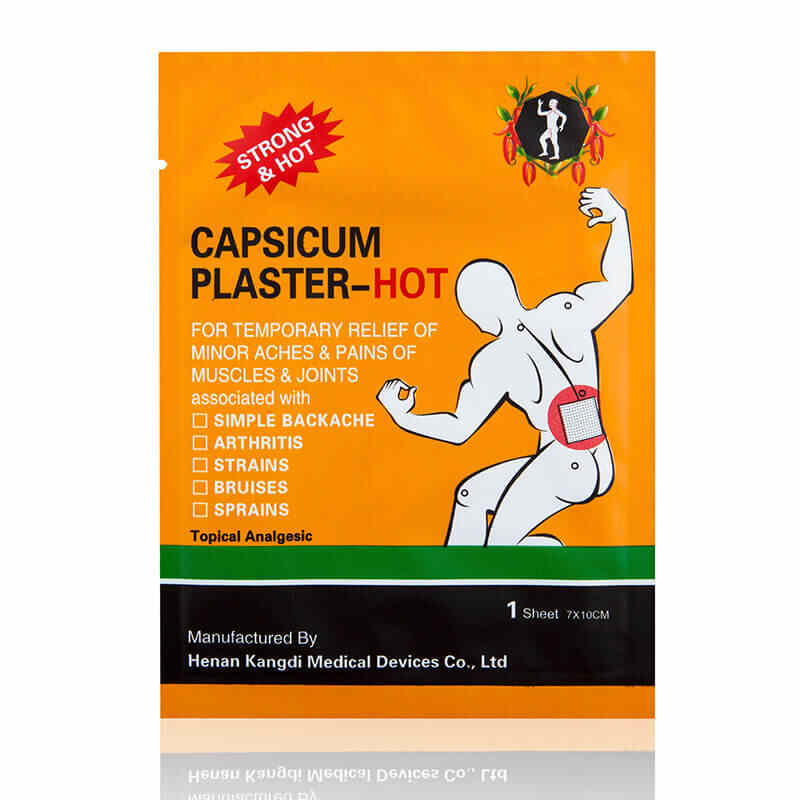
Manufacturers should specify the source and grade of capsaicin used in their formulations. Pharmaceutical-grade capsaicin (typically 95% purity or higher) provides consistent potency and predictable skin reaction profile. Food-grade or technical-grade capsaicin may be less expensive but produces inconsistent results and higher skin irritation risk.
The pressure-sensitive adhesive matrix must hold capsaicin in stable suspension, release it at the correct rate over the wear period, and maintain adhesion under the warming conditions created by the active ingredient. Acrylic-based adhesives are the most common choice for capsicum plasters because of their chemical compatibility with capsaicin and their ability to maintain adhesion at elevated temperatures.
Higher capsaicin concentrations produce more intense warming sensations, which some consumers find uncomfortable. Premium capsicum plasters modulate the warming sensation by combining capsaicin with menthol or other cooling compounds, producing a balanced warming-cooling sensation that consumers describe as more comfortable and effective.
Capsicum plasters are typically worn for 4–8 hours, often during sleep or physical activity. The backing material must be breathable to prevent skin maceration, flexible to conform to body contours, and strong enough to maintain structural integrity at the elevated temperatures produced by capsaicin activity. Non-woven fabric and elastic fabric are the most common backing choices for premium capsicum plasters.
Capsicum plasters containing capsaicin at concentrations used in consumer OTC products (typically 0.025%–0.075%) are generally regulated as OTC monograph products by the FDA. Products making therapeutic claims about pain relief for specific conditions must comply with applicable monograph requirements. Higher-concentration capsicum plasters (such as the 8% patch used for neuropathic pain) require an NDA and are available by prescription only.
In the EU, capsicum plasters are typically classified as medical devices under EU MDR 2017/745, with classification depending on the claims made and the duration of use. Products positioned as traditional herbal medicinal products may qualify for regulation under the Traditional Herbal Medicinal Products Directive (2004/24/EC), which provides a simplified regulatory pathway for products with a long history of traditional use.
Asia-Pacific markets (China, Japan, Korea, Southeast Asia) have long-established regulatory frameworks for capsicum plasters based on their traditional medicine heritage. Your OEM manufacturer should have experience supporting regulatory submissions for your specific target market.
Consumers managing chronic musculoskeletal pain (back pain, arthritis, joint pain) form the largest user segment for capsicum plasters. These consumers use capsicum plasters as part of ongoing pain management routines, often in combination with other therapies. They value consistent efficacy and long-lasting relief over fast onset of action.
Endurance athletes, strength training enthusiasts, and physically active consumers use capsicum plasters for post-workout muscle recovery and minor strain management. This segment values rapid warming onset, strong adhesion during physical activity, and clean removal after training.
In Asian markets, capsicum plasters have a long heritage as part of traditional medicine practices. Consumers in these markets often prefer capsicum plasters over Western-style pharmaceutical pain patches, valuing the natural positioning and the warming sensation associated with traditional use.
Older adults managing chronic joint pain and arthritis are a significant and growing user segment. This segment values gentle adhesion, comfortable wear for extended periods, and reliable pain relief that allows continued daily activity. Capsicum plasters with reduced warming intensity and hypoallergenic adhesive systems are particularly suited to this segment.
Premium manufacturers maintain tight control over capsaicin concentration in the final product, with batch-to-batch variation typically within ±5% of the target concentration. Lower-quality manufacturers may have variation of ±20% or more, resulting in inconsistent user experience and consumer complaints.
Capsicum plasters must adhere reliably for 4–8 hours under a range of skin conditions (dry, moist, warm) and activity levels. Adhesion failure is the most common consumer complaint about budget capsicum plasters. Premium manufacturers use sophisticated adhesive matrix formulations that maintain adhesion throughout the wear period.
Capsaicin is a potent skin irritant at high concentrations. Premium capsicum plasters are formulated to produce the desired warming and pain relief effect without causing excessive skin redness, burning, or prolonged discomfort after removal. Quality manufacturers conduct extensive skin compatibility testing to optimize this balance.
At Kangdi Medical, we have manufactured capsicum plasters for international brands for over 20 years. Our formulation expertise spans multiple capsaicin concentration profiles (from low-concentration 0.025% consumer products to high-concentration 0.075% clinical formulations), penetration-enhanced matrix systems for improved capsaicin delivery, and balanced warming-cooling formulation options for premium positioning.
Our capsicum plaster production capabilities include dedicated production lines with capacity of 5 million patches per month, climate-controlled raw material storage for capsaicin stability, ISO 10993 skin compatibility testing, full regulatory documentation support for FDA, EU CE, and Asian market submissions, and flexible MOQ from pilot batches through commercial-scale production runs.
Capsicum plasters represent a high-margin OEM opportunity with strong consumer demand across multiple geographic markets. The key to success is producing a genuinely quality product with consistent capsaicin concentration, comfortable wear, and reliable pain relief — backed by a manufacturer with deep formulation expertise and regulatory experience.
Contact Kangdi Medical to discuss your capsicum plaster brand concept, target market, and positioning. We will provide a detailed formulation proposal, sample evaluation package, and production plan tailored to your market entry strategy.
Email: kongdy202113@gmail.com
WhatsApp: +86 15517541011
Website: www.kongdypatch.com
Specializing in the integration of scientific research, production and marketing of medical devices


 0086-15517541011
 No.4,2nd Area,SME Poineer Park,Industry Cluster Zone,Huaiyang Country, Zhoukou, Henan, China.
 kongdy202113@gmail.com