
Author: Kongdy Patch
Date: 06 17,2026
If you have ever stood in the foot care aisle of a pharmacy staring at a wall of corn plasters and felt overwhelmed, you are not alone. There are dozens of products, with different shapes, sizes, active ingredients, and claims, and choosing the wrong one can mean wasted money, weeks of ineffective treatment, or even skin damage. The good news is that choosing the right corn plaster becomes much easier once you understand the basic categories of foot problems and the products designed to address each. This buying guide walks you through the four most common foot problems (hard corns, soft corns, calluses, and plantar warts), explains how each is treated, and provides a clear decision tree for matching your specific situation to the right product. The guide is written for consumers but is also useful for retailers stocking the category and brand owners developing product portfolios.
Before choosing any product, you need to identify what is actually on your foot. The four most common conditions have distinct visual and tactile characteristics that you (or a healthcare provider) can use to differentiate them. Hard corn (heloma durum): a small, dense, cone-shaped bump with a visible center or "core," typically on the top or side of toes or on the sole of the foot, painful when pressure is applied directly. Soft corn (heloma molle): a thin, flat, whitish lesion between toes, kept soft by moisture, often painful. Callus (tyloma): a broad, flat, thickened area of skin without a distinct center, typically on weight-bearing areas (ball of foot, heel), generally less painful than corns. Plantar wart (verruca plantaris): a flat or slightly raised lesion with a rough, cauliflower-like surface, often with tiny black dots (thrombosed capillaries), may have pain when pinched side-to-side (as opposed to direct pressure). The first step in choosing the right product is correctly identifying which of these (or another condition) you have.
Once you have identified the problem, the next step is matching it to the right product type. The following decision tree will guide you to the most appropriate product category.
If you have a hard corn (most common): Look for a salicylic acid corn plaster with 30-40% concentration, ring-shaped design to focus the active ingredient on the corn, and durable adhesive that stays in place during walking and bathing. The standard treatment duration is 2-6 weeks, with the plaster replaced every 24-48 hours. Top product picks in this category include discs with 40% salicylic acid in a medicated center, with protective rings to prevent damage to surrounding skin. Brand examples include Dr. Scholl's, Compound W (corn/callus specific), and various private label and international brands.
If you have a soft corn (between toes): Look for a thinner, more flexible product designed for the toe web space, with lower salicylic acid concentration (15-25%) to avoid irritation in the sensitive, moist environment between toes. Many products in this category are designed as toe separators or thin strips that fit between toes. Treatment duration is typically 1-3 weeks. Consider also using toe separators or lamb's wool padding to relieve pressure on the soft corn.
If you have a callus (broader thickened area): Look for larger plasters or medicated pads that cover broader areas, with 20-30% salicylic acid concentration (lower because calluses are more extensive). Some products in this category are designed as full foot masks or overnight treatments. Treatment duration is typically 2-4 weeks. Consider also addressing the underlying cause: ill-fitting footwear, biomechanical issues, or activities that cause the callus to form.
If you have a plantar wart: Plantar warts require special treatment, and standard corn plasters are typically not the best choice. Look for wart-specific products with salicylic acid (typically 17-26% in liquid or gel form, sometimes in pad form), or seek professional treatment (cryotherapy, immunotherapy, laser treatment). If you choose a wart plaster, follow the treatment protocol specifically for warts (which differs from corn treatment) and be aware that warts can take 2-3 months to resolve.
Salicylic acid concentration is the most important variable in corn plaster selection. The standard concentration ranges are: 10-15% (low, for sensitive skin, maintenance, or children), 15-25% (medium, for soft corns, mild calluses, sensitive areas), 25-40% (high, for hard corns, resistant calluses, most effective for typical treatment), and above 40% (very high, prescription-only in many markets, for severe or resistant cases). Choosing the right concentration balances efficacy and safety: too low and the treatment is ineffective, too high and the surrounding skin may be damaged. For first-time users, starting with a medium concentration (20-30%) and adjusting up or down based on results is a reasonable approach. For users with sensitive skin, low concentrations (10-15%) are appropriate but may require longer treatment duration.
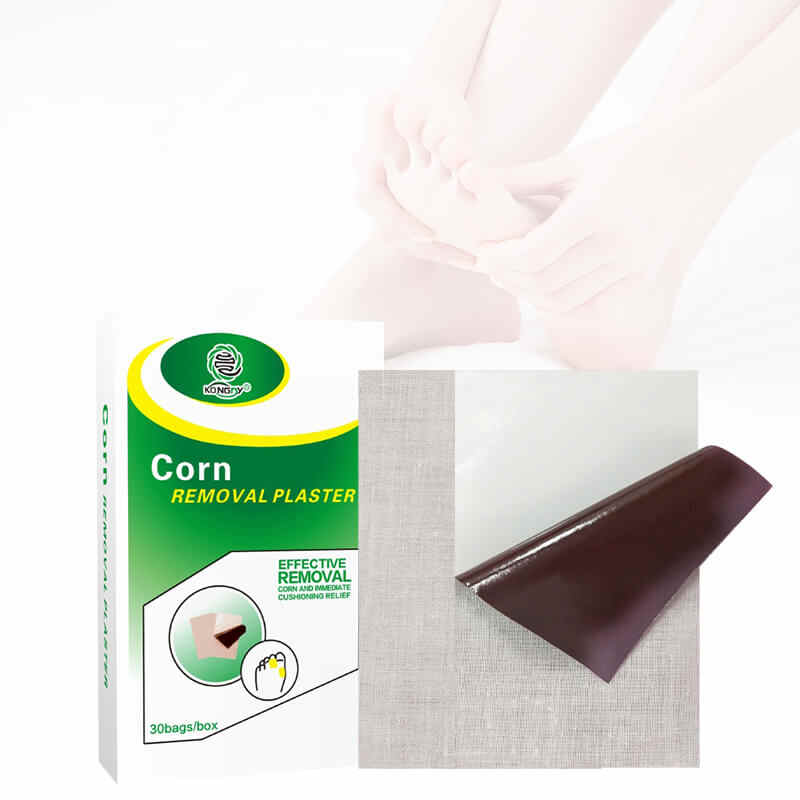
Beyond the active ingredient, several design features affect the user experience and effectiveness. The adhesive strength determines how well the plaster stays in place during walking, bathing, and other activities. A plaster that lifts or falls off provides no benefit. The ring or shield design around the active ingredient prevents damage to surrounding healthy skin — a critical safety feature, especially for higher concentrations. The thickness and flexibility affect comfort and how the plaster feels in shoes. Thinner, more flexible plasters are more comfortable but may be less durable. The water resistance determines how well the plaster survives showering and bathing. The size options should match the typical corn sizes in your specific case. And the packaging format (individual sachets, multi-packs, kits with additional products) affects convenience and value.
Realistic expectations about treatment duration are critical for consumer satisfaction. Hard corns typically resolve in 2-6 weeks of consistent treatment, with the first signs of improvement (softening of the corn, reduced pain) visible within 1-2 weeks. Soft corns resolve faster, typically 1-3 weeks. Calluses typically require 2-4 weeks of treatment. Plantar warts require the longest treatment, typically 2-3 months. During the treatment period, the plaster should be replaced every 24-48 hours, and the softened tissue should be gently removed between changes. The treatment should be continued for the full duration even if the corn appears resolved, to prevent recurrence. Consumers who expect overnight results will be disappointed, but consumers who follow the protocol consistently typically achieve good outcomes.
Some situations require professional medical care rather than self-treatment with OTC corn plasters. See a healthcare provider (podiatrist, dermatologist, or primary care physician) if you have: diabetes (high risk of wound healing complications), peripheral vascular disease (poor circulation increases infection risk), immune compromise (increased infection risk), severe pain that does not improve with self-treatment, signs of infection (redness, warmth, swelling, drainage), a lesion that is bleeding or changing rapidly, numbness or reduced sensation in the feet (may indicate neuropathy), or corns or calluses that keep recurring despite treatment (may indicate underlying biomechanical issues that require professional assessment). Brand owners should include clear "when to see a doctor" guidance in their product information.
Corn plaster prices vary widely based on brand, formulation, and packaging. The typical price ranges are: budget options (USD 5-10 per box of 5-10 plasters, often generic or private label), mid-range options (USD 10-25 per box of 5-10 plasters, established brands with proven formulations), and premium options (USD 25-50+ per box, often with additional features like enhanced adhesives, ergonomic designs, or combination products). The value calculation should consider: cost per treatment day (not per box), treatment duration needed (a cheaper box that requires longer treatment is not always a better value), effectiveness (a more expensive product that resolves the corn in 1 week is better value than a cheaper product that takes 4 weeks), and packaging convenience (multi-day kits with all needed supplies may justify higher per-unit cost).
For hard corns on toes: Dr. Scholl's Duragel Corn Cushions or similar high-concentration (40% salicylic acid) ring-shaped plasters. The thick medicated center and protective ring provide focused treatment. For soft corns between toes: Dr. Scholl's Soft Corn Cushions or thin toe separators with mild keratolytic. For calluses on ball of foot: larger medicated pads like Dr. Scholl's Callus Cushions or overnight foot masks with 20-30% salicylic acid. For plantar warts: wart-specific products with 17-26% salicylic acid in liquid/gel form (Compound W, Dr. Scholl's Freeze Away, or professional cryotherapy). For sensitive skin: low-concentration (10-15%) plasters, urea-based products without salicylic acid, or natural alternatives (pumice stone, moisturizing treatments).
| If You Have... | Product Type | Salicylic Acid | Duration |
|---|---|---|---|
| Hard corn on toe | Ring-shaped disc, 30-40% SA | 30-40% | 2-6 weeks |
| Soft corn between toes | Thin flexible strip, 15-25% SA | 15-25% | 1-3 weeks |
| Callus on ball of foot | Large medicated pad, 20-30% SA | 20-30% | 2-4 weeks |
| Plantar wart | Wart-specific product, 17-26% SA | 17-26% | 2-3 months |
| Sensitive skin | Low SA or urea-based | 10-15% or 0% | Longer treatment |
| Diabetic or immunocompromised | See healthcare provider | N/A | N/A |
The most common mistakes consumers make when buying corn plasters are: choosing based on price alone (cheap products may be ineffective or have poor adhesive), ignoring the concentration (the wrong concentration is the main reason for treatment failure), using corn plasters on plantar warts (different products and protocols are needed), continuing treatment too long without results (most corns should show improvement within 2-3 weeks; if not, reconsider the diagnosis), ignoring the contraindications (the product is not appropriate for everyone, especially diabetics and others with circulation issues), and not addressing the underlying cause (footwear, biomechanics) so the corn keeps recurring.
For brand owners developing corn plaster or foot care product lines, the consumer decision journey above provides valuable guidance. The most successful products clearly communicate which specific foot problem they address, use appropriate salicylic acid concentrations for the indicated use, include design features that enhance efficacy and safety, and provide clear instructions and contraindications. At Kangdi Medical, we support brand owners with corn plaster manufacturing across all the categories above, with formulation expertise, design flexibility, and regulatory documentation for global markets.
Choosing the right corn plaster becomes straightforward once you correctly identify your foot problem, match it to the right product type and concentration, and follow the treatment protocol consistently. For most consumers with simple corns or calluses, OTC corn plasters with appropriate salicylic acid concentration provide effective, low-cost treatment. For more complex situations (plantar warts, diabetic patients, recurrent corns), professional medical care is the appropriate path.
For brand owners interested in developing corn plaster or foot care product lines, contact Kangdi Medical. Our R&D team provides formulation expertise, our design team supports adhesive and packaging innovation, and our regulatory team ensures compliance in target markets.
Email: kongdy202113@gmail.com
WhatsApp: +86 15517541011
Website: www.kongdypatch.com
Specializing in the integration of scientific research, production and marketing of medical devices


 0086-15517541011
 No.4,2nd Area,SME Poineer Park,Industry Cluster Zone,Huaiyang Country, Zhoukou, Henan, China.
 kongdy202113@gmail.com